






Use your Employer or Insurer offered Health Screening Benefits to claim Elev8 Health Screening

The Blueprint for Your Best Self.

100+ biomarkers to map your health. 365 days of AI-powered personal guidance to elevate your health. All starting today.
Trusted by 50,000+ patients
100+ Biomarkers
Same Day Results*
24/7 AI Coach
All Year Support

1

Test 100+ longevity biomarkers

2

Same-day report* with health insights and plan

3

Includes follow-up review with doctor
Evidence-based Science
Longevity Medicine
Precision Health
Holistic Screening
Clinical | Lifestyle Interventions
Whole-person Care
YOUR HEALTH BASELINE

All-in-one. For everyone.
Comprehensive Screening.

Most comprehensive, holistic health assessment.
Add-on* DNA or Gut test, ultrasound and scans.
Assess heart health and metabolic risk
Screen for hormones and thyroid health
Cognition, mood, sleep, brain function
Identify vitamin and mineral deficiencies
Autoimmune, hair loss, skin or gut issues
Personalized plan, transform your health
LONGEVITY BIOMARKERS

What we test

100+ labs that provide the most complete
picture of your current and future health.

Biomarkers Tested

With Ultimate Longevity screening, you gain access to 100+ lab tests annually, covering a wide range of biomarkers. Explore advanced and specialty biomarkers tailored to meet your health needs.

Join us in taking proactive steps towards building your comprehensive health baseline, and earlier interventions to live healthy, longer.

Heart Health & Longevity

Protein found on many “bad” cholesterol particles; higher levels reflect a greater number of these particles in the blood.

Total amount of cholesterol circulating in the blood, including HDL, LDL, and other cholesterol fractions, used as an overall snapshot of blood cholesterol levels to help assess long‑term cardiovascular risk.

Total cholesterol minus HDL; often used as a simple way to estimate cholesterol particles that may be more strongly linked with heart and vascular risk.

“Good” cholesterol that helps carry cholesterol away from arteries and back to the liver for processing and removal.

The main form of fat circulating in the blood, influenced by diet, weight, and metabolic health, and used as a general indicator of how the body is handling fats and energy over time.

“Bad” cholesterol particles that can contribute to plaque build-up in blood vessel walls over time.

Research-based ratio comparing total cholesterol to HDL cholesterol, explored as one way of estimating long-term cardiovascular risk.

Research-based ratio comparing LDL cholesterol to HDL cholesterol, used in studies as another way of describing cardiovascular risk.

Exploratory research ratio showing what proportion of total cholesterol is made up of LDL cholesterol, used as a high-level way to describe overall cholesterol balance.

Exploratory research ratio showing what proportion of total cholesterol is made up of non‑HDL (“non‑good”) cholesterol, used as a high‑level way to describe overall cholesterol balance.

Research ratio comparing triglycerides to HDL cholesterol, explored in studies of metabolic and cardiovascular risk.

Log-based ratio of triglycerides to HDL cholesterol investigated in research as a marker of blood lipid patterns linked with cardiovascular risk.

Research ratio that compares non-HDL (“atherogenic”) cholesterol to HDL cholesterol to summarize overall lipid balance.

Exploratory research ratio looking at how triglyceride levels relate to the number of ApoB‑containing particles, used as a high‑level way to describe overall blood fat patterns.

Research ratio comparing LDL cholesterol to ApoB, used to describe whether LDL particles tend to be smaller and denser or larger and more buoyant, as a high‑level summary of LDL particle pattern.

Research ratio comparing uric acid to HDL cholesterol, explored in studies of metabolic and cardiovascular risk.

Emerging research ratio combining a type of white blood cell (neutrophils) with HDL cholesterol to explore links between inflammation and cardiovascular risk.

Exploratory research ratio comparing testosterone levels with ApoB, used in studies of hormone balance and lipid-related risk.

Metabolic Health Biomarkers

Amount of sugar circulating in the blood at the time of the test, reflecting short-term blood sugar control.

Measure of how much sugar has been attached to red blood cells over the past few months, reflecting longer-term blood sugar patterns.

Waste product from the breakdown of certain foods and body tissues; higher levels can be linked with gout and metabolic health.

Research index combining fasting triglycerides and glucose to describe patterns linked with insulin resistance and cardiometabolic risk.

Research index that combines the TyG index with body mass index (BMI) to explore how weight and metabolism interact in diabetes and cardiometabolic risk studies.

Calculated estimate of blood calcium that adjusts for albumin levels so calcium status can be interpreted more consistently.

Energy Biomarkers

Amount of circulating iron in the blood at the time of the test, helping to put iron availability and related symptoms into context when viewed with other iron and blood markers.

Estimate of how much iron the blood can carry, based largely on transferrin, the main iron-transport protein.

Percentage of available iron-binding sites on transferrin that are currently filled with iron.

Protein that stores iron in the body; also influenced by inflammation.

Hormone made by the adrenal glands that helps the body respond to stress. regulate blood sugar, and manage inflammation.

Exploratory research ratio combining a red blood cell variability marker (RDW) with an iron-storage protein (ferritin), used as a high-level way to describe how red blood cell patterns and stored iron may relate to each other rather than as a stand-alone clinical marker.

Research ratio comparing cortisol and DHEA-S, used to explore adrenal balance and stress-related patterns.

Thyroid Health Biomarkers

Total amount of thyroxine hormone made by the thyroid gland, including both bound and free forms, providing an overall snapshot of thyroid hormone output
that can help give context for how the thyroid is functioning over time.
alongside other thyroid tests and clinical review.

Calculated value that combines total T4 and thyroid hormone binding to estimate the amount of active, unbound thyroid hormone.

Hormone released by the brain’s pituitary gland that signals the thyroid to make more or less thyroid hormone.

Active thyroid hormone that helps regulate energy use, metabolism, and many body functions.

Sex Hormones Biomarkers

Total amount of testosterone in the blood, including both bound and unbound forms, providing an overall snapshot of hormone levels that can help give context to symptoms and wellbeing.

Protein that binds sex hormones like testosterone and estradiol in the blood, controlling how much is freely available to tissues.

Hormone produced mainly by the adrenal glands that acts as a building block for other sex hormones.

Portion of testosterone that is not tightly bound to proteins and is more readily available for the body to use.

Form of estrogen that plays a key role in menstrual cycles, bone health, and many other body systems in all genders.

Research ratio comparing testosterone and estradiol, explored in studies of hormone balance and symptoms.

Calculated estimate of how much biologically active (free) androgen is available relative to binding proteins, offering a high‑level view of overall androgen availability that can help put symptoms and hormone patterns in context.

Liver Health Biomarkers

Main protein made by the liver that helps maintain fluid balance and carries hormones, vitamins, and medicines in the blood.

Ratio comparing albumin to globulins, giving an overview of the major protein groups in the blood and helping to frame patterns related to liver function, nutrition, and immune activity when interpreted with other results.

Enzyme found in liver, bile ducts, and bone; used to explore patterns related to liver or bone conditions.

Enzyme mainly found in the liver; higher levels can indicate liver cell irritation or damage.

Enzyme found in the liver, heart, and muscles. AST is usually interpreted together with ALT and other markers to help describe patterns of liver and muscle stress over time.

Grouped measure of blood proteins other than albumin, including many antibodies and transport proteins. This helps give a broad view of immune and protein status when considered alongside other tests.

Yellow pigment produced when red blood cells are broken down; higher levels can change skin or eye colour and may signal liver or bile duct issues.

Form of bilirubin before it is processed by the liver. It helps give context on how red blood cells are being broken down and how bilirubin is being handled in the body.

Enzyme found mainly in the liver and bile ducts, often used to explore patterns of liver or bile duct stress and alcohol exposure.

Research ratio comparing bilirubin to albumin, explored in studies of severe illness and liver-related risk.

Emerging research ratio relating a liver enzyme (GGT) to HDL cholesterol, studied in metabolic and liver health research.

Form of bilirubin after it has been processed by the liver and made ready for removal from the body. It helps describe how well bile flow and bilirubin clearance are working when viewed with other liver markers.

Ratio comparing AST to ALT that can help describe different patterns of liver enzyme changes.

Exploratory ratio comparing unconjugated and conjugated bilirubin to describe how bilirubin is being processed.

Research ratio comparing two liver-related enzymes, used mainly in studies to explore liver and metabolic patterns.

Kidney Health Biomarkers

Measure of urea nitrogen, a waste product filtered by the kidneys, giving information about kidney function and protein breakdown.

Ratio of two kidney-related markers (BUN and creatinine) often used to help interpret hydration status and kidney function.

Mineral important for bones, muscles, nerves, and blood clotting, tightly regulated in the blood.

Measure related to bicarbonate and carbon dioxide in the blood, giving information about acid–base balance and breathing.

Electrolyte that helps maintain fluid balance and acid–base balance in the body.

Waste product from muscle metabolism that is filtered by the kidneys; commonly used to estimate kidney function.

Calculated estimate of how well the kidneys are filtering blood each minute.

Electrolyte that supports heart rhythm, nerve signals, and muscle function.

Electrolyte that helps control fluid balance, blood pressure, and nerve and muscle function.

Ratio comparing total urea to creatinine, similar in use to the BUN/creatinine ratio in interpreting kidney-related patterns.

Calculated estimate of how much blood the kidneys clear of creatinine each minute, often used in research and dosing decisions.

Thyroid Health Biomarkers

Total amount of thyroxine hormone made by the thyroid gland, including both bound and free forms, providing an overall snapshot of thyroid hormone output
that can help give context for how the thyroid is functioning over time.
alongside other thyroid tests and clinical review.

Calculated value that combines total T4 and thyroid hormone binding to estimate the amount of active, unbound thyroid hormone.

Hormone released by the brain’s pituitary gland that signals the thyroid to make more or less thyroid hormone.

Active thyroid hormone that helps regulate energy use, metabolism, and many body functions.

Nutrients Biomarkers

Cells that carry oxygen from the lungs to the rest of the body and return carbon dioxide to the lungs to be exhaled.

Oxygen-carrying protein inside red blood cells that gives blood its red color.

Percentage of blood volume made up of red blood cells.

Average size of red blood cells, used to help understand different types of anaemia.

Average amount of hemoglobin in each red blood cell.

Average concentration of hemoglobin inside red blood cells.

Measure of how much red blood cell sizes vary from one another. It is often used alongside other red blood cell markers to help frame different patterns of anaemia and nutrient status.

Number of platelets, the blood cells that help with clotting and wound healing.

Average size of platelets, used together with platelet count to understand platelet activity.

Vitamin involved in bone health, immune function, and many other processes.

Research ratio comparing variation in red blood cell size with their average size, mainly explored in studies of different anaemia patterns.

Immune System Biomarkers

Total number of white blood cells, which are part of the immune system and help the body respond to infection and inflammation.

Type of white blood cell that helps the body respond quickly to infections and acute inflammation.

Number of neutrophils in a set volume of blood, giving a more precise view of this immune cell type and helping to put patterns of infection or inflammation into context.

Type of white blood cell involved in targeted immune responses, including B cells. T cells, and natural killer cells.

Number of lymphocytes in a set volume of blood, used to understand overall lymphocyte status.

Type of white blood cell that can move into tissues and mature into cells that help clean up damage and support immune responses.

Number of monocytes in a set volume of blood, giving more detail about this part of the immune system.

Type of white blood cell that can increase with allergies, asthma, and some infections.

Number of eosinophils in a set volume of blood, used to further explore allergic or inflammatory patterns.

Rare type of white blood cell involved in allergic and inflammatory responses.

Number of basophils in a set volume of blood, providing a more detailed view of this rare immune cell type that can help put allergy- or inflammation-related patterns into context.

Research ratio comparing lymphocytes and monocytes, used to explore immune balance in different conditions.

Research ratio comparing platelet count to total white blood cells, used mainly in studies of blood and immune health.

Research ratio comparing neutrophils to lymphocytes, often used to describe patterns of systemic inflammation in studies.

Emerging research ratio that combines neutrophils, lymphocytes, and platelets to explore complex inflammatory patterns.

Research ratio comparing monocytes to lymphocytes, investigated in studies of chronic inflammation and immune activity.

Inflammation Biomarkers

Protein made by the liver that rises when there is inflammation somewhere in the body.

Research ratio comparing ferritin, a marker of iron stores and inflammation, with albumin, a blood protein linked with nutrition and liver function.

Research ratio that relates inflammation (CRP) to albumin levels and has been studied in severe illness.

High-sensitivity version of the CRP test that can detect lower levels of inflammation, often used in cardiovascular research.

Research index combining platelets, neutrophils, and lymphocytes to summarize immune and inflammatory activity.

Research ratio comparing monocytes to HDL cholesterol, explored as a marker linking inflammation and cardiovascular risk.

Research ratio comparing platelets to lymphocytes, used in studies of systemic inflammation and outcomes.

Research index combining neutrophils, monocytes, and lymphocytes to explore inflammatory response patterns.

Research ratio relating CRP to lymphocytes, studied as a marker of inflammation in certain conditions.

Research ratio comparing ferritin and CRP to help distinguish different patterns of iron status and inflammation in studies.

Exploratory research ratio relating an inflammation marker (CRP) to an adrenal hormone (DHEA-S), used as a high-level way to describe how inflammation and adrenal hormone patterns may relate to each other.

Exploratory research ratio comparing testosterone levels with CRP as one way of looking at hormone-inflammation relationships.

Thyroid Health Biomarkers

Total amount of thyroxine hormone made by the thyroid gland, including both bound and free forms, providing an overall snapshot of thyroid hormone output
that can help give context for how the thyroid is functioning over time.
alongside other thyroid tests and clinical review.

Calculated value that combines total T4 and thyroid hormone binding to estimate the amount of active, unbound thyroid hormone.

Hormone released by the brain’s pituitary gland that signals the thyroid to make more or less thyroid hormone.

Active thyroid hormone that helps regulate energy use, metabolism, and many body functions.

For Ultimate Only*

A choice of add-ons available at Extra Cost.

ID# Option Price
Specialized Blood Tests For Men and Women (Can be done along with main blood tests)
UL01 Digestive Enzymes and Pancreatic Function: Amylase and Lipase $109.90
UL02 Heavy Metals Screening: Zinc, Cu, Se, Hg, Pb $529.90
UL03 Prevent Colon Cancer: H. Pylori IgG Antibody Blood Test $44.90
UL04 Prevent Colon Cancer: Urea Breath Test (Comprehensive) $199.90
UL05 SIBO Test: Hydrogen-Methane Breath Test (Comprehensive) $289.90
UL06 Sexual Health: HIV, Syphilis, Herpes (I, II), Chlamydia, Gonorrhea $199.90
UL07 Kidney Failure Risk: Cystatin C and eGFR based on Cystatin C $179.90
UL08 Eyes, Heart and Brain Function: Omega-3 Fatty Acid Profile $299
UL09 Comprehensive Insulin Resistance Screening: KRAFT Test $299
UL10 Thyroid and Weight Imbalances: Thyroglobulin Antibodies (TgAb), Thyroperoxidase Antibodies (TPO), Total T3, Total T4 $179.90
UL11 Comprehensive Hormonal Screening: DUTCH Complete $699
UL12 Growth Factor and Aging Screen: IGF1, IGFBP3 $699
For Men (Blood Test and Scans)
UL13 Additional 3x Cancer Markers: Pancreas, Nose, Testicular $89.90
UL14 Prostate Cancer Risk Screen: Free PSA, Free PSA % $109.90
UL15 Sexual Function and Performance: Sex Hormone Binding Globulin (SHBG), Progesterone $89
UL16 Low Libido or Sexual Drive: Free Testosterone Test $139.90
UL17 Prostate Cancer Screen: Ultrasound Prostate $199
For Women (Blood Test and Scans)
UL18 Additional 3x Cancer Markers: Pancreas, Nose, Breast $89.90
UL19 Ultrasound Pelvis (Abdominal): Assess uterus, cervix, ovaries $139
UL20 Prevent Breast Cancer: Ultrasound Breast (for under 40 yr. old) $139
UL21 Prevent Breast Cancer: Mammogram (for over 40 yr. old) $199
UL22 Prevent Cervical Cancer: Pap Smear (LBC ThinPrep) $89.90
UL23 Advanced Cervical Cancer Prevention Test: HPV DNA $199.90
ID# Option Price
For Women
UL24 Ultrasound Pelvis (Transvaginal): For PCOS/PCOD Diagnosis $189
UL25 Prevent Ovarian Cancer: ROMA Index (Pre / Post Menopause) $149.90
UL26 Fertility and Pregnancy: Ovarian Reserve (AMH), Pregnancy (hCG) $129.90
Ultrasound, Scans and Specialized Tests For Men and Women
UL27 Resting ECG and Chest X-Ray (Filmless) $79.90
UL28 Early Cognitive Decline: Digital Brain Function Screening $89.90
UL29 Bone Mineral Density (BMD): Osteoporosis risk, bone health $139
UL30 Ultrasound Kidneys: Assess kidney function, size, blood flow $139
UL31 Ultrasound Thyroid: Assess abnormalities and thyroid cancer risk $139
UL32 Ultrasound KUB - Kidneys, Ureters and Bladder $179
UL33 Ultrasound Hepatobiliary: Liver, Pancreas, Spleen, Gallbladder $179
UL34 Stroke risk, Plaque buildup (IMT): Ultrasound Carotids $299
UL35 Lung Capacity | Aerobic Fitness: VO2Max (Treadmill) $199
UL36 Diet and Weight Management: Continuous Glucose Monitoring $199
UL37 Ultrasound Abdomen: Hepatobiliary (UL33) + Kidneys (UL30) $235
UL38 Liver Stiffness | Fibrosis: Ultrasound Liver with Elastography $299
UL39 Body Composition DEXA Scan: Assess your body composition, fat and muscle mass $299
UL40 Heart Scan (Hardening Arteries): CT Coronary Calcium Score $329
UL41 Treadmill Stress ECG: Detailed heart function assessment $279
UL42 Heart Health Risk: 2D Echocardiogram (heart health and function) $399
UL43 Biological Age: Epigenetic myTruAge and pace of aging $1,099

Contact us EHS@genixpro.com WhatsApp: +65-88752304 to add-on more than ONE (01) option or if you wish to inquire about other health screening packages.

*Note: Blood test, ultrasound and scans require a visit to our clinic location at Royal Square Novena or Paragon. Ultrasound and scans require an appointment to be scheduled before your visit.

ADVANCED HEALTH INSIGHTS

What You May Learn

A Proactive Approach to Healthy Aging.

While traditional screenings focus on detecting existing diseases or illnesses, Ultimate Longevity takes a proactive approach. We help you evaluate your overall wellness, identify opportunities for optimization, and make data-driven decisions to support your long-term vitality. Learn about:

  • Your lifetime risk for heart health conditions
  • Cardiometabolic risk from insulin resistance
  • Risks associated with nutrient deficiencies
  • Inflammation, thyroid, autoimmune conditions
  • Hormonal imbalances, PMOS, (peri)menopause
...and much more. Elev8 your holistic health.
BETTER. TOGETHER.

Our Specialized Add-on Tests

HOW IT WORKS

Simple Booking Process

If you are concerned about any health condition you have or are worried you may have, we can discuss a functional approach to managing it.

1

Book a Discovery Call

2

Arrange an Appointment

3

We Discuss Your Treatment Plan

4

Further Consultations and Care Plan
HOW IT WORKS

Simple Booking Process

Three easy steps. All from home. It’s that simple.

1

ORDER

Buy Ultimate Longevity package. Add-on tests as needed. We offer over 200 specialized tests from accredited labs worldwide.

2

SCHEDULE

Upon purchase, book your appointment online. Thereafter, we’ll email order confirmation, screening advisory and next steps.

3

DISCOVER

Your test results may be ready either same day or in 2-3 business days. Next, schedule your complimentary report review.

Choose the right package for your needs.

Schedule an online consultation with our experts to discuss your health priorities and to identify the right package, or to combine different packages without duplicating tests.

*Note: Consultation charges apply.
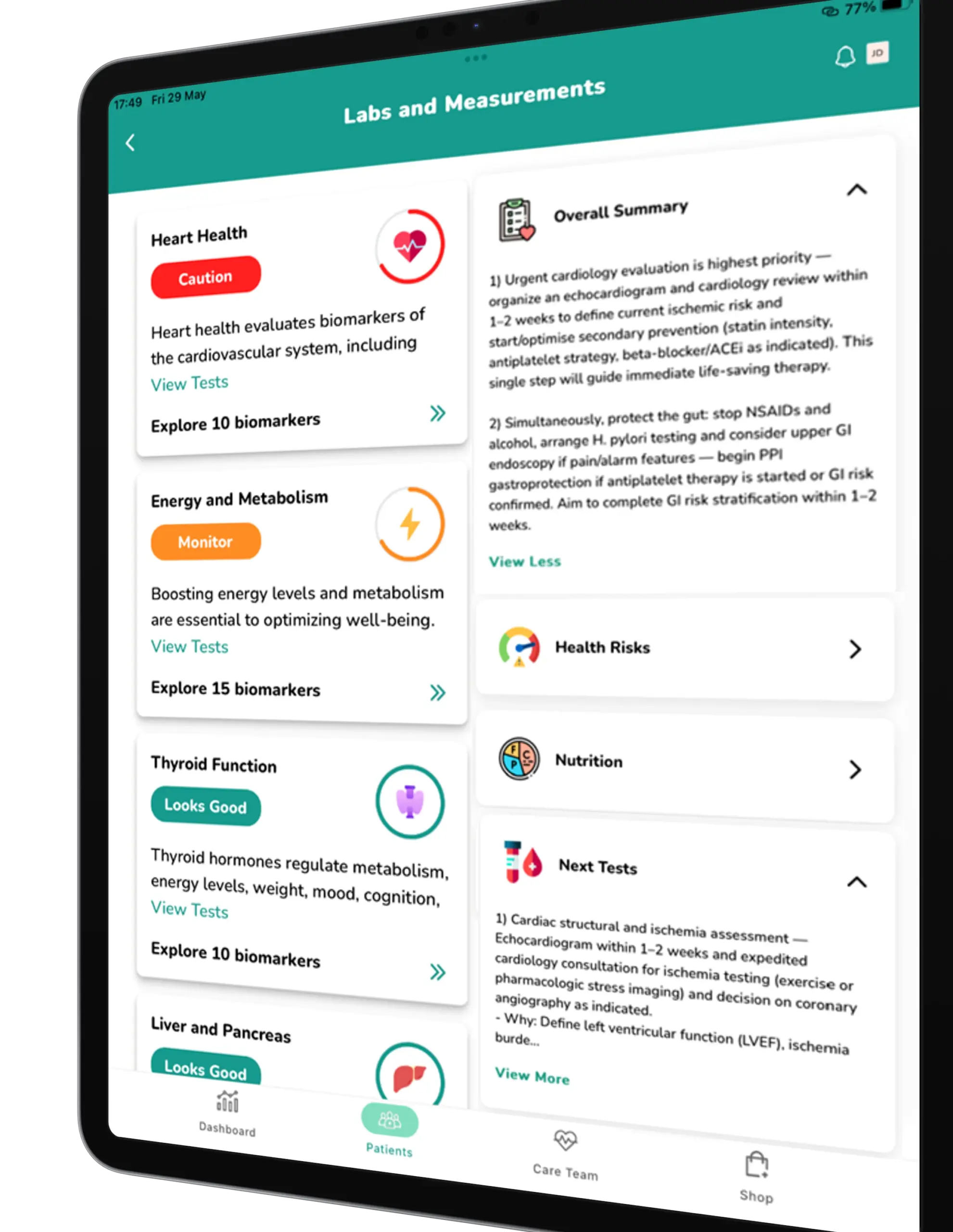
WHAT WE OFFER

A Holistic Health Platform

Besides Ultimate Longevity, we offer several advanced lab tests and scans,
with actionable insights and guidance to help you live healthier, for longer.

Executive Health Check

Choose from a variety of health screening packages for your needs. Flexible options to fully customize your test plan. Schedule tests conveniently at home or clinic.

Ultrasound and Imaging

Add X-Ray, ultrasound, ECG, MRI and CT scan, mammogram, bone mineral density (BMD), treadmill test, sleep and stress tests, brain wave imaging and other advanced diagnostics.

Doctor Consultation

Securely access test results online (on our web portal or in-app). Schedule follow-up* with our doctors via. a tele-consult or in-person visit*. Get clinical and lifestyle advice, medication (if required).

Health Coaching*

Use WYZR™ our instructor-led, digital health coaching platform. Participate in fitness, nutrition, mental health and holistic well-being activities.

24/7 AI COACH. CONTEXT AWARE.

Personalised guidance to act upon, daily.

Get a doctor-reviewed plan tailored to your daily life, covering everything from nutrition and movement to sleep and supplements. Plus, enjoy 24/7 access to an AI coach ready to answer questions and keep you on track.

Your above average health checkup

Elev8 Health
Standard
checkup
Lab tests annually
100+
~30
Same day results in-app
Included
Not included
Includes advanced heart testing beyond cholesterol
Included
Not included
Thyroid, hormones, fertility, (peri)menopause testing
Included
Not included
Nutrient deficiency and electrolytes testing
Included
Not included
Metabolic health & pancreatic enzyme testing
Included
Not included
Personalized action plan and doctor follow-up
Included
Not included
Upload past test results & view trends
Included
Not included
Secure health portal to measure, monitor, track your health
Included
Not included
Claimable under employer or insurer health benefits
Included
Not included
Add-on DNA, gut microbiome or glucose monitoring tests
Included
Not included
Heavy metal, toxins & allergy testing
Included
Not included
Autoimmune disease risk screening
Included
Not included
Access to Ultrasound, MRI & CT scans
Included
Not included
Access to Multi-Cancer Early Detection (MCED) tests
Included
Not included
Access to Parkinson's, Alzheimer's & brain function screening
Included
Not included
Access to health priority analysis, digital health coaching*
Included
Not included
*Launching soon
TRANSFORM YOUR HEALTH

Limited Time Offer

What could cost you thousands is now $499

We make holistic healthcare accessible, affordable, personal.

Employer/Insurer Health Benefits Claimable*

Ultimate Longevity

~$1 /day

Charged annually at $499

Buy Ultimate Longevity
100+ biomarkers tested
Same day test results, AI generated insights & plan in-app
Video follow-up report review with doctor
All-in-one for your whole body
Tracked in one secure portal & app
Clinicians review every lab result and flag issues
Personalized protocol to transform health
Add MRI, CT, specialized tests anytime
Comprehensive, great value screening package
Executive Health Checkup

Customize Your Health Screening

Ideally suited for employees and families either health screening comprehensively for the first time, or do so regularly, and desiring a more holistic health checkup.
  • Early Detection. Lower Cost. Add-on our comprehensive, greatest value Diagnostics | Ultrasound | Lifestyle based health assessments to your chosen package
  • Comfort. Convenience. Choice. No waiting in queues. No travel to clinic. No work disruptions. On-Demand, on-site, at-home* screening. Fully customized. No compromise
  • Unlock Your Full Health Potential. Pair your health screening with WYZR™, our Digital Health Coaching app. Discover engaging activities to optimize your diet, fitness, mental health, and holistic well-being
Frequently Asked Questions

About Healthy Longevity
Screening in Singapore